Showing posts with label Culture. Show all posts

Thursday, December 20, 2012

Bloomsday, a singular celebration.


       June 16th is not an ordinary day in Ireland. On this day every year a celebration takes place where the life of Irish writer James Joyce is commemorated by his fans. The event was invented in 1954 and since then it has become so popular that today it is celebrated in many countries worldwide, but nowhere so brilliantly as, of course, in Ireland and especially in Dublin.


       The celebration includes an huge range of cultural activities, but the main one and the most representative consists in spending the day in the same way the characters from Ulises (a novel by J.Joyce) did. So people eat the same food, wear the same clothes, speak like the characters... And in Dublin, where the story takes places, people even follow the itinerary covered by Leopold Bloom, the main character, from whom the celebration took its name.


Sources:
http://blogs.elpais.com/juan_cruz/2012/06/bloomsday.html
http://www.infoplease.com/spot/bloomsday.html

Off to Éire!

         Hello everyone! After reading so much about Ireland maybe you are thinking about making a trip to the island and feeling the Spirit of Éire for yourself. If so, I'm going to show you in this post several places you cannot miss out.


         Cliffs of Moher. They are located at the southwestern coast of the island and rise 702 feet over the ocean at their maximum heigh.

         The Cliffs took their name from an ancient stronghold that once stood over them. They have appeared in many movies, for example in Harry Potter and the Half-Blood Prince. Take a look at this clip from the movie where you can see them:


         Dublin. Experienced travellers say that Dubliners are the kindest and most friendly people in the world. In the city, you will find infinite ways to have fun and places to visit, like the Guinnes Storehouse and the Dublin Castle.

         And do not forget to take a picture of Molly Malone statue, the young woman who inspired one of the most popular songs in Ireland!


         And finally, you cannot miss some of the spectacular castles sprinkled across Ireland’s lush, green countryside, like Blarney Castle, Bunratty Castle or Doe Castle. 


Bunratty Castle. County Clare, Ireland.

Sources:
http://www.discoverireland.com/us/

Irish around the world


     I’m going to talk about the large number of Irish immigrants there are in the world. Why is this so? Well, many Irishmen during the nineteenth century, emigrated to different parts of the world due to the fact that Ireland wasn’t in its best moment. Ireland was suffering from the called Great Famine (or as the Irish say; An Gorta Mór). This horrible situation was caused by a potato disease. And because of this, and other issues, two million Irish citizens decided to search for a new start, mainly in places such as: Great Britain, United States, Canada, Argentina or Australia. This phenomenon was known as the Irish Diaspora (Diaspóra na nGael).

     A  large majority moved to the United States since it was considered a country of prosperity and freedom. I suppose it was easier for the Irish as they also speak the language. To be more concrete, you can find plenty of Irishmen in the east coast of the country, especially in New York or Boston and other large populations in Philadelphia and Chicago. There are currently over 35 million Irish immigrants in the United States, making it the second-largest ethnic group, behind German-Americans.

     If you ever go to any of these cities you should be on the lookout for: ‘Bronx, Riverdale’ (NY), ‘Charlestown’ (Boston) or ‘Beverly’ (Chicago). These are Irish neighborhoods, where you can really appreciate the Irish influence.

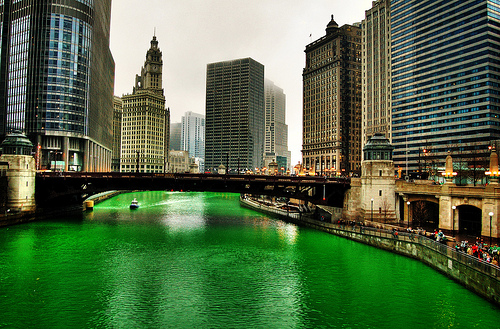
     In fact, the Irish influence is so big that the Americans celebrate St Patrick’s Day with a huge parade. And if you happen to be in Chicago that day, you’ll see that they turn the Chicago river green for this celebration.

                    
     As I mentioned before, not only did they migrate to the US. Great Britain also has a big number of Irish people living there. ‘Kilburn’ (London) or Manchester are other areas where the Irish are predominant.


      Canada also has a large number of Irishmen. It is the 4th largest ethnic group with over 4 million Canadians (14%) with full or part Irish descent. Over two million live in Ontario. The majority arrived in the 1820s to work and settle there. As a result, the countryside is full of neighborhoods and places with names from Ireland. One of these is Corktown, named after the descendents from Cork County. 


Sources: http://www.greenchicagoriver.com/story.html
               http://www.irishtimes.com/timeseye/whoweare/p8topa.htm    

Tuesday, December 18, 2012

Creatures from Éire


        In this post I am going to show you several mythological creatures found in Irish folklore. The amount of these creatures is huge and it is very interesting to notice that some of them can also be found in other places near Ireland. The selection I have done is just based on my own liking. I hope you enjoy it!


         Without a doubt, leprechauns are the most famous legendary creatures in Ireland and today they have become a symbol of the country. They are male fairies who spent their time making shoes. Legends tell that in war times they earned huge amounts of gold and they keep it hidden in a vessel hidden at the end of a rainbow. This is the reason why they are regarded as a sign of prosperity and good luck. They appear like old men and even if they are usually represented wearing green clothes, actually old legends tell about red ones. It is also said that if a human captures a leprechaun, they will grant three wishes as an exchange for his freedom.


        Selkies are mythological creatures found in Scottish, Icelandic and Irish folklore. In Ireland, they are also known as roane. They are shape-shifters, living as seals in the waters and becoming human on land after shedding their skin. Both, male and female selkies are said to be incredibly beautiful creatures and legend tells that if a man find the skin of a selkie, he can demand her to marry him and she won't refuse to do it. Another legend about this creature tells that selkies cannot watch humans for too much time before going back to the ocean.


Stamps depicting selkies from Faroe Islands.


        Banshees are probably one of the darkest creatures in Irish folklore. They are female spirits regarded as omens of death and messengers from the hereafter. Legends tell that they appear before somebody announcing that a relative of him or her is going to pass away soon. They usually can be seen crying, screaming and bawling but some other times they only are noticeable for their shrieks.


        The púka or pooka is one of the most feared creatures in Irish folklore. They are evil fairies that are said to be able to change their shape. They usually appear as a fearsome black horse that runs through the fields ruining the harvest and destroying farms. This is one of the most frequent shapes they adopt, but the real shape of the pooka is actually pretty much ridiculous in comparison: they are just little and deformed fairies similar to trolls.


        Irish mythology, along with all its creatures and stories, has helped to develop the fantastic genre in such a way that, without it, fantasy would not be the same at all nowadays.

Christmas in Ireland

     In Ireland as in most of the Eastern countries, Christmas is the largest and most important celebration of the year, taking place between the 24th of December to the 6th of January. Christmas decorations have to be taken down on this last day known as “Little Christmas”, and it is said to bring bad luck to take them down before then.
     As in Spain, it is an Irish tradition for people to decorate their houses by setting a traditional crib. They also set the Christmas tree which is officially set up on the 8th of December to commemorate the Immaculate Conception. The placing of a ring of Holly on doors originated in Ireland as Holly was one of the main plants which flourished at Christmas time and poor people used them to decorate their houses. This plant along with ivy, are also used by the Irish in Christmas to decorate graves.
Candles are lit and placed on the windows to symbolize hospitality for Mary and Joseph as a way of saying that there is room for them in these houses. It also used to indicate a safe place for priests to perform mass because during the Penal Times this was not allowed.
     It is a tradition that the candle should be lit by the youngest member of the house and only be extinguished by a girl named “Mary”.
     In older years, after the Christmas Eve meal, the kitchen was again set and on it they placed a piece of bread filled with caraway seeds and raisins, a glass of milk and a large lit candle. The door to the house was left unlocked so that Mary and Joseph could make use of the welcome.


     Santa Clause, or “Daidí na Nollag” (Daddy of Christmas) also visits the Irish Kids!
     Traditionally, before going to bed, kids left a mince pie and a bottle of Guinness for Santa Claus and carrots for Rudolph; but because of the American influence, recently the mince pie is been replaced with cookies and Guinness with milk… Sure Santa or “Santy” (as they call him) is not very happy with this change.
     There is an Irish recent tradition called “The Christmas swim”; on Christmas morning people take a swim at the sea, often done in aid of charity. It officially started in 1965. Arlon Owens and his friend Victor Davies would go for a swim in the sea everyday including Christmas day year after year. When people started gathering to watch these men dipping into the icy waters at the Porthcawl harbor they decided to treat it as a fund-raising spectacle. Today is a national organization called “The Porthcawl Christmas Swim” with thousands of spectators and swimmers every year that contribute to the founding.
Check out their web site: http://christmasswim.org/ 
                            Hope you all have a wonderful holidays and 'Nollaig Shona Duit' (Merry Christmas)

Sunday, December 9, 2012

Food and Language

Traditional Food of Ireland

    The traditional Irish recipes are simple: Only few, cheap ingredients are used. Nowadays it is not strange to find chefs preparing new, modern versions of the typical Irish plates like Irish stew, Beef and Cabbage, Potate and cabbage or Colcannon. As a surprise for people wanting to taste these typical Irish plates they are not at all typical on restaurant menus. This does not mean they are not eaten any more but that more than restaurant dishes they are plates made to enjoy home with the family.


                                                               Beef and Cabbage

    Can you believe that Colcannon is so popular among the Irish that there is even a song about it! Listen to the song and if you feel inspired you can even try preparing it.


                                                                     Colcannon


    Traditionally Irish cuisine is a peasant cuisine and as we can imagine food in poor household is never wasted. The best example of this is the pig. When beef was considered as a "food for the rich" pigs were kept by many families and it is said that they ate every part of it except for the grunt.

Crubeens (the feed of pig), tribe (stomach) and drisheen (a blood sausage) are still typical in Cork.   
 
  
   When there were no refrigeration in Ireland yet, the parts of the pig that could not be eaten fresh were cured or salted. That is how bacon became an important part of the Irish diet.

    In Ireland Summer means berries: wild blackberries, rosehips and wild strawberries are abundant throughout Ireland. As the weather in Ireland is wet and warm in late summer and early autumn, wild mushrooms can be found  in large amounts. When autumn goes on there are  nuts, in particular hazel and beech nuts. Crab apple is also a common autum fruit in Ireland. 

     
    "Rocks along the shoreline are often dense with mussels.  Crabs and shrimp can simply be picked from rock pools when the tide goes out and limpets, clams and periwinkles are also there for the taking."

    Not surprisingly these are all ingredients used in traditional dishes.


The Potato
 

    The potato is propably the most symbolic ingredient and food in Ireland. I could write a whole post just about potato in Ireland-so many ways of cooking and preparing the potato they have!  The potatoes are eaten boiled, fried, mashed, baked, chipped, mixed with cabbage or scallions. They make potato cakes and they use it even to top pies. Don't be surprised if you find potatoes cooked in two different ways on the same dinner plate!

    There is an Irish brand of potato crisps called Tayto. A typical Irish thing to do is to buy these crisps on the way home after a night out.


Whiskey & Guinness in Irish Cooking

    Whiskey and Guinness are typical Irish drinks but is it true that just taking any recipe and adding it a bit of whiskey you can convert it into an Irish recipe? Does Irish cuisine really make use of these two so well known drinks? Truth is that the Irish always prefere to drink whisky than use it in cooking but that Guiness is actually used sometimes when preparing stews and also as a marinade.


Sources:
http://www.ravensgard.org/prdunham/irishfood.html
http://www.dochara.com/the-irish/food-history/history-of-irish-food/

Wednesday, November 21, 2012

Sláinte!

     Once we have dealt with some introductory aspects, let's see something that I am sure you already know or that you have heard about. Ireland is worldwide known by its beers. Our goal in this post will be to show you some terms (either in English or Gaelic) related to beer.

     Before all, we have to distinguish three brands of beer in Ireland by their manufacturing process: Lager ("smooth, elegant, crisp, and clean" ), Ale ("hearty, robust, and fruity") and the most typical one, Stout, with a dark color, heavy, and richly flavored.


     If you ask somebody about the best Irish beer, you will probably get this answer: Guinness; actually the most ever know Irish stout First elaborated in the 18th century, it has its own history, tradition and museum as well.  Somebody said it is "a rich and creamy Irish favorite, this hearty brew is best straight out of the bottle", well I guess it is a matter of taste.

     Now, let's imagine you are in an Irish pub in which it is spoken a particular Gaelic dialect; 
How would you say "Get me a pint of Guinness, please!"? 
Pionta Guinness, le do thoil
And "Cheers!"?           
Sláinte!
What about "Are you drunk?"?
An bhfuil tú ar meisce?
If we are asking somebody "Are you going to drink?" we will say:  
An mbeidh deoch agat?

     Then we can also distinguish between bottle (buidéal), glass (gloine), pint (pionta), mid-glass (leathghloine) and mid-pint (leathphionta) as measures for a beer.

     I hope you have fun with a stout, or as they would say a "leann dubh", when you are spending some time Ireland.

Sources:
http://www.gayot.com/beer/top10irishbeers/main.html
http://unzaragozanoenirlanda.wordpress.com/2011/06/23/las-cervezas-irlandesas-irish-beers/
http://innisfree1916.wordpress.com/curso-de-irlandes/

Wednesday, November 14, 2012

Religion in Ireland

    The predominant religion in Ireland is Christianity, with the largest church being the Roman Catholic Church. In 2011, 84.2% of the population identified themselves as Roman Catholic. The Catholic population of both the Republic and of Northern Ireland together is about 3,9 million. Most churches are organized in all-Ireland basis which includes both Northern-and Republic of Ireland. The Catholic church is involved in education and health services.

    The second largest Christian denomination, the church of Ireland or the Anglican church, declined in membership for the most of the twentieth century, but has more recently experienced an increase. In the 2011 census 269,811 people (5.9%) had no religion, with 3.905 and 3,521 people describing themselves as “atheist” and “agnostic” respectively. Those who did not state a religion numbered 72,914 (1,6%).

    The patron saints of Ireland for Catholics and Anglicans are Saint Patrick, Saint Bridget and Saint Columba. Sain Patrick is the only one of the three who is commonly recogniced as the patron Saint. Saint Patrick’s day is calebrated in Ireland and abroad on 17 March.


Religion and education

    Large number of schools in Ireland are runned by religious organisations but parents can ask for their children to be excluded from religious study if they wish so. However, religious studies as a subject was introduced into the state administered Junior Certificate in 2001; it is not compulsory and it deals with aspects of different religions not focusing on one particular religion.

    Freedom of religion for belief, practice, and organisation is guaranteed to every citizen. Ireland is in general a place where there is great tolerance and respect for diversity in religious belief, leaving the situation in Northern Ireland aside.


The Role of Religion in Modern Ireland


    “It is interesting to note that while 90% of people stated that they were Catholic in the 2006 census, a Europoll conducted several months earlier found that just 72% of people believe there is a God which appears to suggest that there is a large number of Catholics in Ireland who do not believe in God.” These apparantly irreconcilable numbers can be explained by looking at the place religion has in everyday life in Ireland. By European standards church attendance is still relatively high - 60%. Still the reduction on the 85% who attended church regularly 25 years ago is huge. Church is starting to be more and more a place to go on special occasions like to babtize children, to get married or to bury their dead.

     “Being Catholic, or Protestant, in Ireland is as much a cultural as a religious statement – it’s a statement about a heritage rather than a belief. There was often a significant misunderstanding by outside observers looking at the long running conflict in Northern Ireland who frequently saw it as a “religious war”. It never was, it was a struggle between communities with diverse histories and cultures. Thus the well known gag about the Belfast man who stated that he was Jewish, only to be asked “Yes, but are you a Catholic Jew or a Protestant Jew?”


Fdo: Anna-Leena Launonen

Sources:
http://en.wikipedia.org/wiki/Religion_in_the_Republic_of_Ireland
http://www.dochara.com/the-irish/facts/about-religion/