Showing posts with label History. Show all posts

Thursday, December 20, 2012

Irish around the world


     I’m going to talk about the large number of Irish immigrants there are in the world. Why is this so? Well, many Irishmen during the nineteenth century, emigrated to different parts of the world due to the fact that Ireland wasn’t in its best moment. Ireland was suffering from the called Great Famine (or as the Irish say; An Gorta Mór). This horrible situation was caused by a potato disease. And because of this, and other issues, two million Irish citizens decided to search for a new start, mainly in places such as: Great Britain, United States, Canada, Argentina or Australia. This phenomenon was known as the Irish Diaspora (Diaspóra na nGael).

     A  large majority moved to the United States since it was considered a country of prosperity and freedom. I suppose it was easier for the Irish as they also speak the language. To be more concrete, you can find plenty of Irishmen in the east coast of the country, especially in New York or Boston and other large populations in Philadelphia and Chicago. There are currently over 35 million Irish immigrants in the United States, making it the second-largest ethnic group, behind German-Americans.

     If you ever go to any of these cities you should be on the lookout for: ‘Bronx, Riverdale’ (NY), ‘Charlestown’ (Boston) or ‘Beverly’ (Chicago). These are Irish neighborhoods, where you can really appreciate the Irish influence.

     In fact, the Irish influence is so big that the Americans celebrate St Patrick’s Day with a huge parade. And if you happen to be in Chicago that day, you’ll see that they turn the Chicago river green for this celebration.
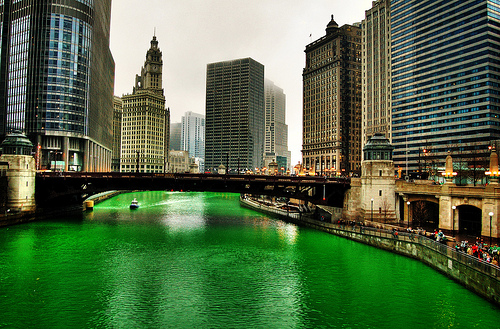
                    
     As I mentioned before, not only did they migrate to the US. Great Britain also has a big number of Irish people living there. ‘Kilburn’ (London) or Manchester are other areas where the Irish are predominant.


      Canada also has a large number of Irishmen. It is the 4th largest ethnic group with over 4 million Canadians (14%) with full or part Irish descent. Over two million live in Ontario. The majority arrived in the 1820s to work and settle there. As a result, the countryside is full of neighborhoods and places with names from Ireland. One of these is Corktown, named after the descendents from Cork County. 


Sources: http://www.greenchicagoriver.com/story.html
               http://www.irishtimes.com/timeseye/whoweare/p8topa.htm    

Saturday, December 15, 2012

Boston Celtics

DO YOU RECOGNIZE THIS IMAGE?

Well, if you love sports and specially basketball you probably do. 
What has this to do with the Irish?...
Who is this guy?...
Why is he wearing these clothes?...
All these questions you'll probably be wondering about will be answered in this post.

Ladies and gentlemen, you're going to let me introduce this image; this is the logo of the franchise of the Boston Celtics, one of the best basketball teams of all times, this is a classic of the NBA.


    Image belonging to the official site of the boston celtics: http://www.nba.com/celtics

And, is it related to the Irish? Yes, listen; after the Great Famine in the middle of the nineteenth century in Ireland, a great part of the population had to leave their country to move to the United States looking for new lives. The first cities populated by Irish people were in the east coast of the USA. Boston became one of the centers to the arrival of Irish people.

That's the reason why Walter Brown (owner of the franchise) decided to choose a Leprechaun (wearing a waistcoat full of shamrocks) as a symbol of the team, because of the influence of the Irish in that city. Furthermore, the name of the team holds the word "Celtics" referring to the origins of the Irish.


Sources:

http://descubreirlanda.blogspot.com.es/

Wednesday, November 21, 2012

The History of Éire

     We don’t know too much about what was going on in Ireland until the arrival of Christianity due to the lack of written sources of information. However, from this period, we still preserve a large amount of megalithic remains all over the island (like dolmens, menhirs and cromlechs) along with remains of mine production.


Poulnabrone dolmen, the Burren, County Clare.


     Coming from Central and Eastern Europe, the Celts will arrive at the island in the 4th century BC. This new people, who are very similar to the Gauls in Gallia or the Britons in England in terms of culture and lifestyle, will replace the original settlers of Ireland.


     Despite the Celts will be scarcely organized, living in small little kingdoms (and even fighting each other) the Romans won’t be interested in conquering Ireland (as they did with Britannia) what made possible the survival of the Celtic culture for much longer. However, they will be interested in doing business with the Celts and this will lead to the cultural rapprochement between them. The arrival of Christianity is the best example of Roman influence in this society. In the 5th century, the whole island will have assimilated the new religion and many monasteries will be built.


Round tower at Kildare Abbey, County Kildare. Kildare monastery was one of those that were built by the Christians during the 5th century in Ireland. The only portion of the original building that remains today is the Round tower. 


     It is very interesting to notice the name that the Romans used for Ireland: Hibernia. It comes actually from Greek and means “land of the winter”. They also referred to Ireland as Scotia (“land of the Scoti”) since the Scots originally came from Ireland.


     Attracted by the wealth of Irish monasteries, in the 8th century the first Viking invasions took place in the island. This nation founded Dublin and occupied the territories around this city and for two centuries they will spread terror around the island plundering and destroying everything in their path. This situation will last until 1014, when they will be defeated in battle by Irish king Brian Boru.


     In the 12th century a new invasion took place in Ireland. The Normans, leaded by Henry II of England, conquered the Island and soon after, Ireland became part of the British Crown and many new castles and fortress were built.


     The British dominion of Ireland will last over seven centuries. During this period there will be many rebellions which will be harshly crushed, and this situation will become even harder when Henry VIII broke with the Church of Rome and imposed the doctrine of the new Anglican Church.


     Finally, in 1912, a law which allowed the administrative autonomy of Ireland was passed by the English Parliament. However, the outbreak of the First World War paralyzed the process and the law wasn’t applied which lead independence movements to get angry and declare the independence in 1916.


     The British army crushed the uprising in 1919. However, the struggle for the independence persisted until 1921, when the Anglo-Irish Treaty was signed. This treaty meant the much-anticipated independence of Ireland, although the North of the island still remained as part of the British Kingdom. Nevertheless, many people weren’t in agreement with the division and this eventually leads to the outbreak of a civil war that devastated Ireland from 1922 until 1923.


     In 1949, Ireland severed its last constitutional ties to Great Britain and an Irish Republic was finally proclaimed.